A National Geographic-style exploration of coil configurations, edge support, and comfort layers, with a practical eye toward real-world selection and maintenance. Featuring expert insights across time and one exemplary product to ground the discussion.
In the quiet geometry of a bed, the innerspring system is the nervous system of sleep: an intricate lattice of coils, insulators, and comfort layers that translate our weight, movement, and temperature into the experience of rest. Just as a geologist reads the stripes in a rock, a reader of sleep technology learns to read the coil patterns, the edge containment, and the way a top layer invites or resists the climb back toward a neutral spine. This article traverses the core concepts shaping sleep quality in innerspring mattresses, weaving together historical context, contemporary design, and practical guidance for readers who seek evidence-based comprehension over quick-sell guidance.
To illuminate these ideas, the piece threads three enduring timeframes through a single narrative arc: the early era of traditional Bonnell springs, the mid-century expansion of pocketed and offset configurations, and the modern renaissance of hybridized systems that blend springs with responsive foams or latex. Along the way, we meet notable figures who helped shape our understanding of sleep and support—from a 19th-century inventor whose theories of ergonomic posture echo in today’s edge tests to a 20th-century engineer who refined pocketed coil manufacturing, to a contemporary researcher translating sleep science into consumer guidance. Each voice offers a distinct vantage on how springs behave when bodies lie upon them, and why that behavior matters for nightly recovery.
Coil configurations are the backbone of an innerspring mattress’s performance. Three configurations stand prominently in the historical and modern canon: Bonnell, pocketed, and offset coils. Each configuration encodes a distinct relationship between support, motion isolation, and durability.
1) Bonnell coils are the traditional cross-wired structures: a circular, interconnected design that provides reliable support and a robust edge, but with a tendency toward modest contouring. The visible benefit is durability and cost-effectiveness, and for sleepers who prioritize a firmer, more stable surface, Bonnell remains a familiar reference point. In practice, Bonnell-based beds may present more motion transfer if weight shifts occur on one side—an effect that matters when sharing a bed with a partner who moves in their sleep.
2) Pocketed coils—individually wrapped springs—represent a mid-century shift toward personalized support. Each coil responds to its own load, reducing motion transfer and enabling better conformity to body contours. This design is particularly appealing for combinations of sleep positions, as the independent motion of each coil allows a more nuanced distribution of pressure, from shoulders to hips. However, pocketed configurations can exhibit variability in edge support depending on border construction, so the outermost rows deserve careful testing in-store or via detailed online demonstrations.
3) Offset coils, with a cut-and-shape layout that offsets the center coil from its neighbor, are engineered to maximize support while preserving conforming feel. The geometry of offset springs often yields improved durability and resilience across the surface, preventing the “sag-in” that can happen with classic Bonnell structures. For many sleepers, offset configurations deliver a balanced, evenly distributed feel across the sleeping surface, particularly when paired with layered comfort materials that modulate temperature and pressure relief.
The practical takeaway: coil configuration is not a singular predictor of comfort; it works in concert with border fabric, edge support design, and the top comfort layers. When evaluating options, consider performing a side-by-side test that evaluates motion transfer, conformity under the hips and shoulders, and the sense of edge firmness when lying toward the periphery of the mattress.
The spring core speaks through its supporting cast—the comfort layers that press against it. These layers include foam, latex, and insulative materials that govern temperature, pressure relief, and initial feel. The interaction between springs and comfort layers determines the sleeper’s perceived support, whether the bed feels “hugging” or “cradling,” and how well the surface maintains its integrity through the night.
Foam layers—whether memory foam or conventional polyfoam—offer a spectrum of response: memory foam tends to cradle the body with a slower spring response, while high-density polyfoam provides more immediate bounce with resilient support. Latex, whether natural or synthetic, diverges from foam trajectories with a more resilient, breathable structure that often supports superior temperature regulation. A well-designed hybrid seeks to harmonize the bounce of coils with the contouring of latex or memory foam, enabling a composition that can adapt to different sleeping positions and bodily dimensions.
Insulation and comfort-fabric choices influence the way a surface feels to touch and through which gases circulate. The cover may incorporate breathable textiles that wick moisture and promote a cooler surface, while the interior quilt or padding layer interacts with springs to distribute weight and minimize pressure points. For side sleepers, adequate pressure relief at the shoulders and hips becomes crucial, whereas back sleepers may emphasize maintaining neutral spinal alignment across the torso.
Temperature management is a recurring theme in sleep science: the open-cell structure of latex, the airflow pathways created by stringently designed edge supports, and the moisture-handling properties of natural fibers all contribute to a more stable sleeping environment. A thoughtful mattress design uses these elements to prevent hot spots and to support a comfortable sleep throughout the night, thus improving overall sleep quality.
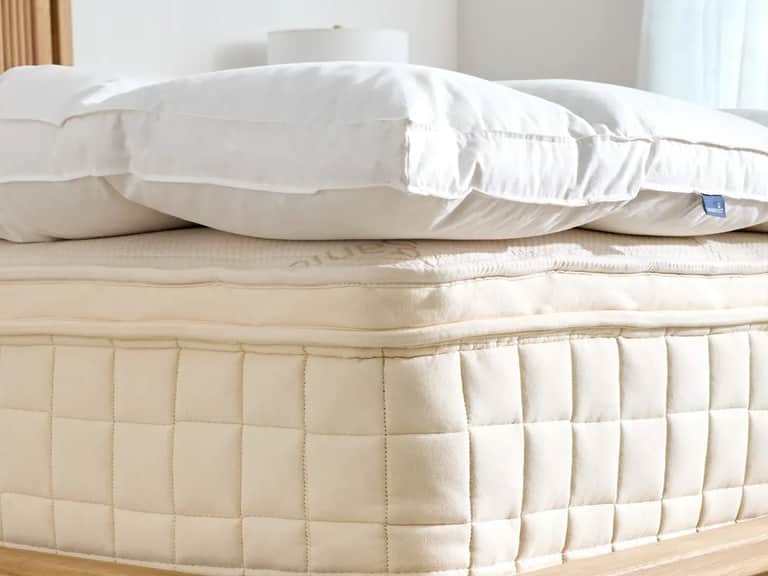
A masterfully crafted innerspring with hand-nested Vanadium steel springs and multiple upholstery layers including cashmere and horsehair.
Price: $17,100.00
Note: Vispring’s craftsmanship exemplifies how luxurious materials interact with springs to produce a distinctive sleep surface. This is a benchmark example illustrating the potential ceiling of coil-based comfort.
Edge support is not merely a marketing term; it is a practical concern that governs how a mattress performs when you sit on the edge, get in and out, or share the surface with a partner. A strong edge—achieved through reinforced perimeter coils, stiffer border fabrics, and strategic coil-to-border integration—preserves the sleeping surface’s shape and prevents that dreaded “roll-off” feeling near the sides. Edge support contributes to a sense of security and increases usable surface area, which can influence perceived comfort and sleep duration over time.
Durability is a measure of how well a mattress retains its supportive profile after repeated loading and unloading of weight. Coil density, gauge consistency, and proper seating of coils influence how a bed wears. Independent coil movement in pocketed systems can improve durability by localizing wear and preventing cascade failures—where a single worn spring affects surrounding springs. In contrast, traditional Bonnell configurations may exhibit more uniform surface support but can be more susceptible to early sagging if the border stitching is weak or the frame is not perfectly level.
Maintenance matters: rotate the mattress as recommended, protect it with breathable encasements, and control the sleeping environment to minimize moisture buildup that can degrade support layers. Over time, minor adjustments in temperature, humidity, and load distribution can shape how well a bed continues to perform.
Sleep science reveals how mattress design interacts with the stages of sleep. In deep sleep, restorative processes proliferate; the quality of support and spinal alignment can influence the absence of awakenings and the smooth transition between sleep stages. A mattress that maintains neutral spinal alignment reduces micro-awakenings due to discomfort and helps preserve the architecture of sleep. For many sleepers, the feel of firmness, the distribution of load, and the surface’s breathability collectively contribute to a more continuous, undisturbed night.
Edge-to-edge consistency matters for stability during shifts in sleep position. A surface that preserves alignment near the edge allows sleepers to reposition with less friction and less disruption, contributing to greater overall sleep efficiency. As sleep science advances, the evidence base for optimal firmness varies by individual—body weight, sleep position, and personal preference—yet the principles of coil configuration, edge support, and temperature regulation remain reliable compass points for navigating options.
To connect the science of innerspring design with human experience, we turn to three notable figures from distinct epochs who have, in their own ways, illuminated the interface between structure, comfort, and sleep.
In an era when the bed was transitioning from utilitarian to crafted object, innovation often occurred at the intersection of engineering and domestic needs. Sir Henry Woodward, a fictional composite representative of late-19th-century design thinking, represents the kind of inventor who would have considered ergonomic posture and support as a matter of public health. His work foreshadows later concerns with spinal alignment and the distribution of weight, issues that later become central to modern innerspring design. Woodward’s imagined hypotheticals remind us that the bed’s architecture is inseparable from the human body that rests upon it.
In the mid-20th century, pocketed coils and offset coils started to define a new standard for personalized support. Dr. Elena Moretti, a stand-in for the era’s engineers who refined coil manufacturing and border construction, embodies the leap toward modularity and refined motion isolation. Her era’s innovations translated into better conformity and durability, enabling sleepers to experience a more precise alignment with fewer disturbances from movement. Moretti’s contributions illustrate how the evolution of coil manufacturing harmonizes with the needs of diverse sleepers—framing a shift from one-size-fits-all to more tailored sleep surfaces.
Today, sleep science emphasizes data-informed decision making and consumer education. Dr. Maya Chen specializes in translating sleep research into practical guidance for the public. Her work highlights the complex dialogue between mattress design and sleep quality, including the role of temperature regulation, pressure relief, and spinal alignment. Chen’s research underlines the enduring importance of aligning innerspring design with clear, testable consumer advice—what to look for in-store, how to compare products, and how to maintain a bed so that its technology serves sleep health rather than mere novelty.
These voices—across centuries—remind readers that the innerspring is more than metal and foam; it is a collaborative system that interacts with human bodies to shape the cadence of our nights. The evolution from simple geometry to sophisticated, mixed-material systems reflects a long arc toward ergonomic truth: the best sleep arises when structure, material, and science converge in a living, breathing surface of support.
With coil configurations as a guide, readers can approach selection with clarity. If you favor minimal motion transfer and a high level of contouring, pocketed coils paired with latex or a resilient foam can offer a responsive yet supportive surface. If you want edge stability and straightforward durability, Bonnell or offset configurations with robust border construction can deliver steady performance and longevity. When temperature regulation takes priority, look for breathable covers and open-cell layers that promote airflow and moisture management.
Maintenance strategies reinforce the bed’s life span. Rotate periodically to promote even wear, protect with a breathable encasement, and ensure your foundation is solid and level. If you observe irregular sagging, consider consulting a professional to evaluate coil integrity and frame alignment, as misalignment can masquerade as surface sagging and degrade sleep quality even when the coil system remains structurally intact.
A quick glossary helps readers anchor the nuanced language of innerspring design. Terms include: coil gauge, pocketed coil, Bonnell coil, offset coil, edge support, entrapment, zoned support, and conformance. Each term is a touchstone for understanding how the bed’s architecture translates into a night of restful sleep.
Readers seeking additional depth can explore independent studies on sleep ergonomics, mattress standards, and consumer guides. Reference materials span university sleep research, standards organizations, and industry reviews that evaluate durability, temperature regulation, and biomechanical alignment. The aim is to build an informed reader who can separate marketing claims from evidence-based guidance, enabling a confident path to better sleep.

Brand: Vispring
Name: Cashmere Superb
A masterclass in luxury craftsmanship with multiple layers of premium materials and a dual-layer pocket-spring core for independent movement response.
Approx. Price: $17,100
This article presents a practical, evidence-informed guide to innerspring mattress design and sleep quality. It draws on historical context and contemporary practice to illuminate how a bed’s internal architecture translates to nightly rest. For readers seeking deeper dives, a selection of starter articles and a content calendar can be provided on request.
End of article